Tag: RV trip planning

  • Friday Night Camping Tips for Weekend RVers

    Friday Night Camping Tips for Weekend RVers

    If you’re a weekend RV camper like we are, your trips probably follow the same rhythm.

    Work all week.
    Pack Thursday night.
    Leave straight after work on Friday.
    Pull into your campsite sometime between sunset and “where did the daylight go?”

    That’s exactly why having practical Friday night camping tips matters more than most people think. Because Friday evening isn’t a full vacation day.

    It’s a transition.

    And if you treat it like a full adventure day, Saturday — your only real day — ends up paying the price.

    First, Let’s Be Honest About Timing

    Before we go any further, let’s clarify something important.

    If we arrive at a campground at 2:00 or 3:00 in the afternoon with full daylight and no work stress behind us, that’s a completely different situation. We might take a short walk and maybe explore a little. We might ease into the park while the sun is still high.

    But that’s not the typical Friday scenario for most weekend RVers. rida

    Most of the time, we arrive after work. We’re tired. Daylight is fading. Our brains are still half in “email mode.”

    That’s when the rules shift. And that’s where the most important of all Friday night camping tips comes into play — something I call The First Night Rule.

    What The First Night Rule Actually Means

    The First Night Rule isn’t about doing nothing. It’s about doing the right things in the right order when energy is low and daylight is limited.For after-work arrivals, The First Night Rule means:

    • Safe, unhurried setup
    • A very simple dinner
    • Sitting down after set up & dinner to relax

    No full hikes.
    No ambitious park exploration.
    Along with no pressure to “make the most of it.”

    Just land. Enjoy the calm. Reset.

    When we pull into a park close to dusk, we use to remind ourselves that Friday night is not an activity night (now it is just what we do-a habit).

    It’s transition night. That mindset alone lowers stress.

    Friday Night Camping Tips #1: Lower Expectations about Arrival

    One of the biggest mistakes weekend campers make is expecting Friday night to feel like Saturday.

    It won’t.

    You’ve worked all day. You’ve driven. You’re navigating a site in fading light. Your mental bandwidth is thinner than you think. The smartest Friday night camping tips start with lowering expectations.

    That shift changes everything.

    Friday Night Camping Tips #2: Slow Setup Beats Fast Setup

    Arriving in low light changes depth perception. You can’t see the slope clearly. You’re guessing at tree branches. Even experienced RVers feel that subtle tension backing in at dusk.

    One of our most practical Friday night camping tips is simply this: slow down.

    Don’t rush.

    No trying to impress neighbors with your skills

    No irritation if something takes longer than expected.

    Level carefully. Double-check hookups. Use extra lighting if needed (headlamps are great for this).

    This is part of The First Night Rule. Calm beats fast every time on a late Friday arrival.

    Friday Night Camping Tips #3: Make Dinner Almost Boring

    Friday is not gourmet night.

    If you want your weekend to feel relaxed, dinner must be simple. This might be the most underrated of all Friday night camping tips.

    For us, that means:

    • Pre-made food from home
    • Sandwiches and chips
    • Something that reheats in microwave

    The goal is to be sitting outside within 30–45 minutes of finishing setup. If it takes longer than that, we need to bring less.

    I have always made a meal at home that is easy to warm up…I think a lot of campers have spaghetti on Friday night because it’s an easy prep meal. It just made sense to have an easy meal; now looking back, that was probably one of my best newbie ideas. Because Saturday deserves your energy — not Friday dinner.

    Friday Night Camping Tips #4: Protect Your Only Full Day

    Weekend camping gives you one golden day.

    Saturday is for:

    • Morning coffee outside
    • Hiking trails
    • Time by the river or lake
    • Scenic drives
    • Doing absolutely nothing

    If you burn mental and physical energy Friday night, Saturday starts at 60 percent instead of 100.

    One of the most overlooked Friday night camping tips is recognizing that energy is limited — especially after a work week.

    When we honor the First Night Rule, we wake up refreshed on Saturday. Coffee tastes better. We’re not already irritated from pushing too hard the night before.

    And that changes the entire weekend.

    Friday Night Camping Tips #5: Do Less Than You Think You Should

    This is where people sometimes push back. “But we always hike the first evening,” or “We love exploring right away.” And that’s fine — if you arrive early with energy to spare.

    But when we’re arriving after work in fading light, doing less actually makes the weekend feel longer. It’s ok to take a short walk to stretch your legs if your drive is long.

    But stop there.

    The best Friday night camping tips include giving yourself permission to pause.

    Sit outside.
    Listen to the sounds of nature.
    Watch other campers settle in.

    You don’t need an activity to justify being there. Sometimes the quiet first hour is the reset you didn’t realize you needed.

    Why The First Night Rule Works

    All of these Friday night camping tips flow into one simple idea: protect the transition.

    The First Night Rule works because it acknowledges reality:

    • You’re tired.
    • It’s getting dark.
    • Saturday matters most.

    It isn’t rigid. It isn’t universal. It applies the most to after-work arrivals with limited daylight. Because we have:

    Less friction.
    Better sleep Friday night.
    More energy Saturday morning.

    Short Texas trips began feeling restorative instead of compressed.

    A Gentle Challenge for Your Next Weekend Trip

    On your next weekend RV trip — especially if you’re arriving after work — decide ahead of time that Friday has a different purpose.

    Keep dinner simple.
    Move slowly during setup.
    Leave the schedule blank.

    Let Saturday hold the adventure.

    The most practical Friday night camping tips aren’t about squeezing in more. They’re about protecting what little time you actually have camping. And when you follow The First Night Rule on after-work arrivals, you’ll notice something subtle but powerful:

    Your only full day feels bigger.
    Your patience lasts longer.
    And your weekend feels calmer.

    Not because you did more.

    But because you knew when to stop and take time to watch the stars.
  • The Smart March RV Camping Strategy for Texas

    The Smart March RV Camping Strategy for Texas

    Cold Mornings and Warm Afternoons

    March camping in Texas keeps you humble. You step outside at sunrise wrapped in a hoodie, clutching a hot cup of coffee, and by mid-afternoon, you’re hunting for short sleeves and cracking open the windows. If you’ve camped here long enough, you already know that March does not believe in consistency. That’s exactly why you need a solid March RV camping strategy instead of just tossing random layers into a duffel bag and hoping for the best.

    Texas in early spring is a tug-of-war between winter and summer. One day brings crisp 40-degree mornings, and the next feels like late April. It’s the temperature swing that impacts everything inside your RV, from propane usage to humidity levels to how comfortable you feel sitting under the awning at 4 p.m. A March RV camping strategy makes those swings manageable instead of miserable.

    Why March in Texas Feels So Extreme

    March weather changes fast across Texas. Cold fronts still sweep through, but strong sun angles warm everything quickly by midday. That combination creates rapid temperature swings. Your RV absorbs overnight chill, and then by mid-afternoon, the interior can feel stuffy and warm, especially if you’re parked in direct sun.

    These swings aren’t just about comfort. They affect condensation inside the rig, how often your furnace kicks on, and even how well you sleep. When you understand this pattern, you can build your March RV camping strategy around it instead of reacting to it.

    The key is to expect fluctuation. Plan for two seasons in one day.

    Mastering Layering Clothing (Without Packing the Closet)

    If you’ve ever overpacked for a spring trip, you know how fast closet space disappears. A good March RV camping strategy doesn’t mean bringing every sweatshirt you own. It means building simple, mix-and-match layers.

    Start with breathable base layers. Think lightweight long sleeves or simple tees that can stand alone in the afternoon. Add one mid-layer, like a fleece or a thin sweatshirt, that provides warmth without bulk. Then include a lightweight outer layer, such as a windbreaker or packable jacket. That outer layer often matters more than a heavy coat because March wind can cut through you even when temperatures aren’t terrible, no matter what part of Texas you are camping in.

    For bottoms, comfortable jeans or thicker leggings handle cool mornings, while one pair of lighter pants or capris covers warmer afternoons. Shoes should follow the same principle. Closed-toe shoes for chilly mornings and sandals for the sunny stretch.

    The goal isn’t variety. It’s versatility. When every piece works with every other piece, you eliminate half your clothing and still feel prepared. Layering well often comes down to knowing your packing tendencies. If you’ve ever wondered why you consistently bring too much or not quite enough, I share a deeper look at the different RV packing personalities here.

    Packing Smart for Temperature Swings

    Packing for March requires restraint. It’s easy to think, “What if it’s freezing?” and then panic-pack bulky items. Instead, think in removable layers. A solid March RV camping strategy focuses on function, not fear.

    Choose clothing that folds small and dries quickly. Avoid heavy sweaters that take up half a cabinet. Roll items instead of stacking them to maximize space. Store rarely used cold-weather gear in an overhead compartment rather than prime closet space. Smart packing reduces clutter and keeps your RV feeling calm instead of chaotic.

    Propane Awareness During Temperature Swings

    Cold mornings mean your furnace will run more than you expect. In March, it may not run all night, but those early morning cycles can quietly drain propane if you’re not paying attention. A thoughtful March RV camping strategy includes checking tank levels before you leave and knowing how long your typical overnight usage lasts.

    If you’re on full hookups, a small electric space heater can reduce propane use, but it must be used carefully and never overloaded on a circuit. If you’re dry camping, propane management becomes even more important. Set your thermostat a little lower at night and use layered bedding instead of relying solely on heat.

    It’s also wise to track interior temperatures with a small digital thermometer. RV thermostats are not always perfectly accurate. Knowing the actual temperature inside your rig helps you avoid overheating in the afternoon, when the sun quickly warms the space.

    Propane awareness is an important part of any March RV camping strategy.

    Managing Humidity Inside the RV

    March mornings often bring condensation on RV windows. That’s because cold exterior air meets warm interior air overnight. Add in showers, cooking, and even breathing in a small space, and humidity rises quickly. Humidity sneaks up fast in small spaces, which is why I’ve shared a more detailed look at how we monitor and manage moisture inside our RV in this guide.

    When afternoon temperatures spike, that trapped moisture can make the RV feel sticky. A practical March RV camping strategy includes airflow. Crack a roof vent slightly overnight if the weather allows. Use your vent fan when cooking. Wipe down window condensation in the morning so it doesn’t sit and create long-term moisture issues.

    In especially damp conditions, a compact dehumidifier can make a noticeable difference. Even small adjustments in airflow dramatically improve comfort. Humidity control isn’t glamorous, but it’s part of what separates a comfortable spring trip from a frustrating one.

    Afternoon Heat Surprises

    By 3 p.m., especially on clear days, the interior of your RV can warm up quickly. Sunlight hitting one side of the rig makes a noticeable difference. Part of a balanced March RV camping strategy involves managing solar gain.

    Use your awning strategically to shade windows. Close blinds on the sun-facing side during peak heat. Open opposite-side windows to create cross-ventilation. These small adjustments often prevent the need to run the air conditioner on mild afternoons.

    Outdoor comfort matters too. Bring lightweight camp chair blankets for mornings and evenings after the sun goes down.

    Sleep Comfort When Nights Are Cold

    Nighttime temperatures can drop quickly in March, even after warm afternoons. Instead of cranking up the furnace, adjust your bedding. Flannel sheets or a slightly heavier blanket layered over lighter bedding works well. You can always peel layers back if you get too warm.

    A good March RV camping strategy includes preparing your bed for fluctuation. Keep an extra throw within arm’s reach rather than stored away. That way, you’re not climbing out of bed at 2 a.m. because the temperature shifted again.

    Sleep quality makes or breaks a trip. Managing warmth thoughtfully helps you wake up refreshed instead of chilled.

    The Beauty of March Camping in Texas

    The unpredictable nature of March is also what makes it special. Fewer crowds. Blooming wildflowers are starting to show. Crisp mornings that make coffee taste better. Warm afternoons are perfect for hiking or sitting outside without summer heat pressing down.

    When you approach it with a plan, a March RV camping strategy turns wild temperature swings into part of the journey instead of a source of frustration. You expect the hoodie in the morning. You anticipate the short sleeves by the afternoon. You monitor propane without obsessing over it. You control humidity before it becomes a problem.

    Texas in March will always keep you guessing. But with layering clothing, propane awareness, humidity control, and smart packing strategies, you’re no longer reacting. You’re prepared.

    That’s the difference between simply surviving early spring camping and genuinely enjoying it. And once you dial in your March RV camping strategy, those cold mornings and warm afternoons start to feel less like chaos and more like charm.

    March may be chaotic, but you don’t have to be.

  • How to Book a Texas RV Campsite Without Losing Your Mind

    How to Book a Texas RV Campsite Without Losing Your Mind

    The Struggle Is Real—and You’re Not Alone

    If you’ve recently tried to reserve a campsite and felt like screaming at your screen—you’re in good company. State parks, Corps of Engineers (COE) sites, county-run campgrounds, and even private RV parks are all filling up faster than ever. What used to be a peaceful hobby has turned into a digital scramble. Whether you’re a seasoned weekend warrior or a first-time RVer, the frustration is real. We’ve felt it too. We’ve hit refresh dozens of times, logged in early, planned months ahead, and still missed out.

    But you’re not powerless. While the demand has exploded, there are still ways to plan smarter and increase your chances of landing that perfect campsite.

    Why Is It So Hard to Book a Site Now?

    A few years ago, you might have been able to book a site a few weeks—or even days—in advance. Now, sites are getting scooped up as soon as booking opens. Several things are contributing to this:

    – The post-pandemic surge in RV ownership
    – Limited availability of electric and full-hookup sites
    – Increased popularity of state and federal parks
    – New remote workers traveling full-time in RVs

    More campers + limited sites = frustration. But understanding the system can give you a major edge.

    What You Need to Know Before You Book

    Preparation is everything when it comes to booking campgrounds. Before you click “Reserve,” make sure you know:

    – The length of your RV and whether you need a back-in or pull-through site
    – Whether you need a 30 or 50 amp hookup
    – If you require full hookups, water/electric only, or can manage with dry camping
    – Your desired location: shaded, near water, near a bathhouse, etc.
    – Your exact travel dates and how flexible you can be
    – Your camping crew: pets, kids, accessibility needs

    Having these details ready helps you search faster and avoid filtering through sites that won’t work.

    Planning Ahead Is Key

    Set yourself up for success by planning ahead—sometimes well in advance. Many Texas State Parks allow booking 5–6 months in advance. Some private parks open reservations up to a year out. If you know you want to camp over a holiday or during peak season, it’s essential to plan and begin making reservations as soon as possible.

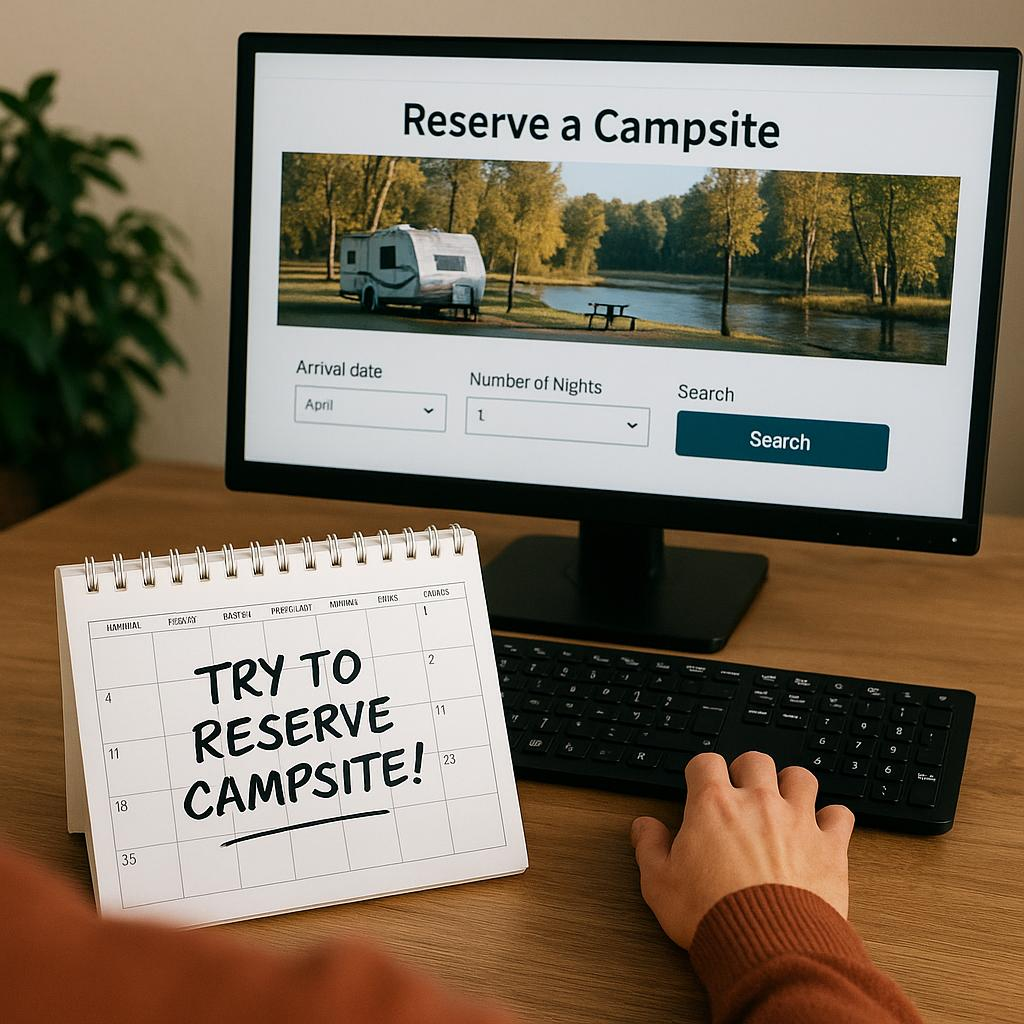
    We recommend maintaining a camping calendar—either digital or physical. Mark down important reservation windows. Use reminders or alarms a few days before and the morning of booking windows. Sounds excessive, but sometimes it’s the excessive effort that gets you the site you want.

    Apps like Campendium, RV Life, The Dyrt, and CampNab are also great tools to help you scout sites, find cancellations, and read reviews in advance.

    Tips on How to Book Texas State Parks

    Texas State Park systems operate on a rolling reservation window—usually 5 or 6 months in advance. Reservations open at 8 a.m. local time, and popular parks can fill in minutes.

    * Create your account in advance and log in early.

    -Use the email option to receive an email notification when a cancellation occurs. However, those who requested an email when a cancellation occurs are also rushing to secure the booking.
    – Set multiple reminders in your phone or calendar
    – Know your exact dates and have backups ready
    – Use the ‘sliding window’ trick: book a longer stay that starts earlier than your target date, then cancel extra days later
    – Be flexible with weekdays instead of weekends

    Tools that help: CampNab, state park email alerts, and setting “favorites” on booking platforms to move fast

    Hacks for Booking Corps of Engineers (COE) Parks

    COE campgrounds are known for scenic sites and great prices—but they also book quickly. Reservations open 6 months in advance via Recreation.gov.

    – Have your Recreation.gov account ready and be logged in early
    – Use the flexible date search feature to see what’s open nearby
    – Target mid-week stays or off-season trips for more availability
    – Consider checking parks that are a little farther from metro areas

    Tools that help: Recreation.gov mobile app, browser autofill for faster checkout, and the Campflare alert system for cancellations

    How to Book at a Private Park

    Private parks often offer more amenities and allow for longer stays, but they don’t all have modern booking systems—and they fill up during peak seasons too.

    – Don’t rely solely on online booking—call the park directly
    – Ask if they have a waiting list or last-minute cancellations
    – Join loyalty or membership programs for early access
    – Be polite but persistent—cancellations happen all the time
    – Avoid holidays and school breaks when families book early

    Tools that help: The Dyrt PRO, RV Parky, and joining Facebook groups for campground swap alerts

    Hacks to Book a Site at a County & City Parks

    Often overlooked, county and city-run parks can be just as easy to book and just as beautiful. These vary widely by region but can be real hidden gems.

    – Research lesser-known parks through local tourism websites
    – Call or email the parks department—some require manual reservations
    – Use Google Maps to spot campgrounds not listed on major apps
    – Ask locals or other RVers for recommendations

    Tools that help: Local county websites, Google Reviews, Campendium, and RV Life Trip Wizard

    Final Thoughts: You’re Not Alone

    It’s easy to feel defeated when you’ve planned a trip and can’t find an open site—but don’t give up. The system may feel stacked against you, but with the right strategy, a bit of patience, and some backup plans, you’ll find your way.

    We’ve all been there. We’ve stayed up late refreshing pages, only to watch our dream site disappear. But we’ve also scored last-minute sites, found new favorite parks off the beaten path, and learned to make the most of weekday trips and shoulder seasons.

    Keep planning, stay flexible, and remember—the goal isn’t just to reserve a spot, it’s to enjoy the journey.

    Here are the key websites and resources mentioned—perfect for bookmarking or adding to your planning toolkit:

    Reservation Platforms

    Texas State Park booking (ReserveAmerica):
    https://texasstateparks.reserveamerica.com

    Corps of Engineers & federal campgrounds (Recreation.gov):
    https://www.recreation.gov


    Cancellation Alert & Planning Apps

    CampNab – Paid cancellation-alert service:
    https://campnab.com/ (Hipcamp Help, campnab.com)

    Campflare – Free campsite alert service:
    https://campflare.com/ (Campflare)

    Hipcamp Alerts – Uses Campflare backend for alerts via Hipcamp:
    https://www.hipcamp.com/alerts (hereandthere.club)

    RV Travel & Campground Discovery Tools

    Campendium – Reviews, maps & cell service info:
    https://www.campendium.com

    RV Life – Trip planning, campground database:
    https://www.rvlife.com

    The Dyrt – Public & private campground listings, PRO memberships:
    https://www.thedyrt.com

    RV Parky – Private park directory & reviews:
    https://www.rvparky.com

  • Reliable Tips for Surviving RV Breakdowns in Texas

    Reliable Tips for Surviving RV Breakdowns in Texas

    Let’s face it—breaking down in your RV on a Texas highway isn’t anyone’s idea of a good time. Whether you’re rolling through Hill Country or cruising the remote stretches of West Texas, things can go sideways fast. But with a bit of planning, a stocked emergency kit, and the right know-how, you can keep a bad day from turning into a disaster.

    This guide walks you through what to do if your RV breaks down in Texas, who to call for help, and what to keep in your camper to stay safe and stress-free. Trust us—being prepared makes all the difference.

    🚨 When Trouble Hits: What to Do If Your RV Breaks Down in Texas

    We’ve all feared it: one minute you’re humming along with the radio, and the next your dashboard lights up like a Christmas tree. Here’s how to keep your cool when things go wrong.

    1. Pull Over Safely and Stay Alert

    As soon as you notice a problem:
    – Turn on your hazard lights.
    – Slowly move to a broad shoulder, rest stop, or nearby parking lot.
    – If you’re on a busy Texas highway, get as far off the lane as safely possible.

    2. Stay Inside If It’s Not Safe

    If traffic is zooming past, remain buckled inside with your flashers on. Only exit if it’s safe. Place reflective triangles or road flares 6–10 feet behind your RV to warn oncoming vehicles.

    3. Set the Scene for Safety

    If you must exit your RV:
    – Use the passenger side door away from traffic.
    – Set the emergency brake, shift to park, and turn your wheels away from the road.
    – Wear a high-visibility vest, especially at night.

    📞 Who to Call for Help: Roadside Assistance in Texas

    Depending on where you break it down, Texas has several services that can help RVers—some of them are even free!

    1. Texas HERO Roadside Assistance

    City/RegionHighway CoverageHERO Phone Number
    AustinI-35, US 183, SH 71, Loop 1, US 290512-974-HERO
    San AntonioI-10, I-35, I-410, US 281, TX 151210-732-HERO
    El PasoGreater El Paso highways915-790-HERO
    Permian BasinI-20, SH 191 (Midland/Odessa)877-699-HERO

    📌 Pro Tip: Add these numbers to your phone before your trip.

    2. Texas Department of Public Safety Roadside Help

    Flip over your Texas driver’s license—you’ll find this number:
    📞 1-800-525-5555

    It connects you with DPS dispatch. While they won’t send a tow truck, they will send a trooper to assist and help you stay safe while you wait.

    🚗 What to Pack: The Ultimate Texas RV Emergency Kit

    You don’t need a full mechanic’s shop, but having the right gear on board can save your trip. Here’s what every RVer in Texas should keep in their rig:

    – First-aid kit
    – Reflective triangles or road flares
    – High-visibility vest
    – Spare tire, jack, and lug wrench
    – Portable tire inflator or Fix-a-Flat
    – Jumper cables or portable jump starter
    – Small fuel and oil container
    – Basic tool kit (duct tape, zip ties, screwdrivers, pliers)
    – Flashlight + extra batteries
    – Bottled water + non-perishable snacks
    – Printed Texas road map (don’t rely only on GPS)
    – Portable phone charger or battery pack

    🛠️ RV-Specific Safety & Maintenance Tips

    ✅ Watch Your Weight Balance

    Uneven loading can cause sway or even damage to the axles. Distribute gear evenly and avoid overloading the rear.

    ✅ Secure Everything Before Driving

    Loose items—like coffee pots, tool bins, or cast-iron skillets—can shift or fall. They could break something… or someone.

    ✅ Check Batteries Before Every Trip

    If your house battery is weak, you could lose lights, fridge cooling, water pressure, and more. Test your batteries regularly.

    ✅ Inspect Slide-Outs and Awnings

    Before every trip and during setup, check for tears, misalignment, or motor issues. One stuck awning can ruin your weekend.

    🧰 Avoid the Breakdown: Your Pre-Trip Maintenance Checklist

    The best emergency? The one that never happens. A simple pre-trip walkaround can prevent 90% of the most common RV breakdowns.

    ✔️ Do This Before You Hit the Road:
    – Top off all fluids (oil, coolant, transmission, brake)
    – Check tire pressure on all tires, including the spare
    – Test your lights, blinkers, and brake lights
    – Make sure your wipers work (Texas dust can be brutal)
    – Fill your fuel tank at least halfway, especially in rural areas
    – Listen for squeaks, knocks, or rattles—then inspect further

    🧡 Real Story: Why It Pays to Be Prepared

    Our daughter once broke down on a remote Texas highway. She remembered the DPS number from her driver’s license and called. A kind trooper showed up and took her to a nearby McDonald’s to wait safely for us to make the 2-hour drive. It turned a scary situation into something manageable.

    💡 The Big Takeaway

    Texas roads are big, bold, and beautiful—but also remote and occasionally unforgiving. A roadside emergency doesn’t have to be a nightmare. With the right plan, gear, and knowledge, you can handle breakdowns like a pro and get back to enjoying your RV adventure.

    So remember:
    – Know who to call
    – Keep your emergency kit current
    – Do a walkaround before every trip
    – Stay calm and safe if trouble strikes