
RV Batteries Don’t Have One Expiration Date
If someone had told me our RV batteries were three years old, that information wouldn’t have meant much to me. Three years old. Okay. Were they old? Were they practically new? Should I be concerned? I honestly wouldn’t have known.
I knew RV batteries eventually needed to be replaced, but I had never given much thought to how long they were actually supposed to last. When we bought our current RV, we inherited the house batteries that were already in it. We knew the previous owners had recently been using the RV, so we assumed the batteries were fine. And they were.
But if you’re wondering how long do RV batteries last, there isn’t one number that applies to every RV. The type of battery matters, but so does how the battery has been charged, used, maintained, and stored.
Fortunately, you don’t need to become a battery expert to understand what that means.
What Is the Average Life of an RV Battery?
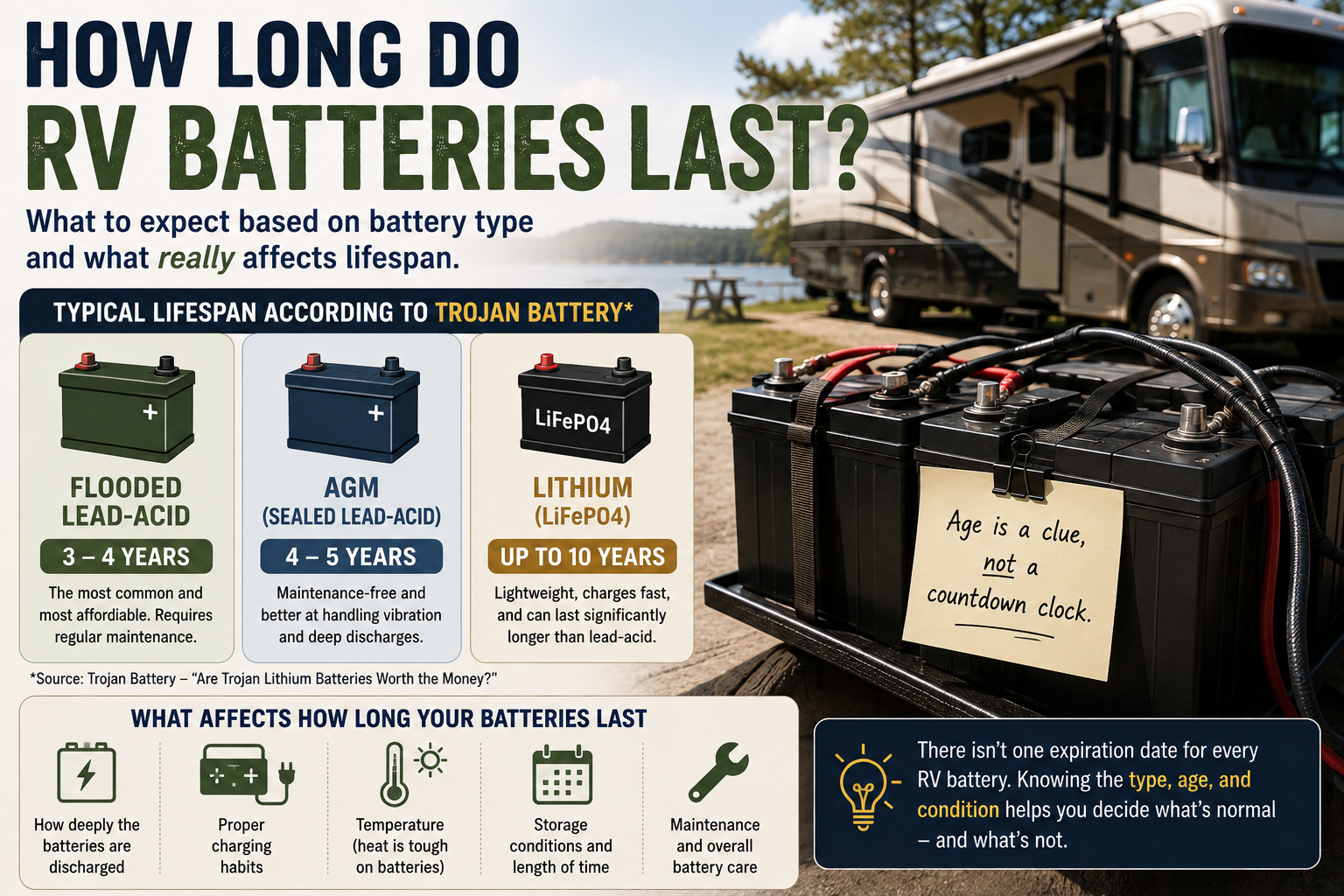
There are several types of RV house batteries, and they don’t all have the same expected lifespan. According to Trojan Battery, flooded lead-acid batteries may last about three to four years, while AGM batteries may last about four to five years. Trojan says its lithium batteries can last up to 10 years. Those numbers immediately gave me some context I didn’t have before.
If someone tells me an AGM battery is three years old, I now understand why the age might be worth knowing. It doesn’t automatically mean the battery is bad, but it tells me where that battery may be in its expected lifespan. The same three-year-old battery would mean something very different if it were lithium. The important word in all of this is ‘may’.
A battery doesn’t reach its fourth birthday and suddenly stop working. These are general lifespan estimates, not expiration dates.
What Type of RV Battery Do I Have?
And here comes the question I couldn’t answer when we started this article. I don’t know. If you’re in the same boat, that’s okay. But knowing the battery type gives you a much better starting point for estimating how long your RV batteries might last.
Flooded lead-acid batteries are a traditional type of RV battery and require some routine maintenance. AGM batteries are also lead-acid batteries, but they’re sealed and have different maintenance requirements. Lithium batteries, usually LiFePO4 in RV applications, are a different battery technology and can have a considerably longer potential lifespan.
Your battery itself should have identifying information on it. Your RV documentation may also tell you what was originally installed, although a previous owner may have replaced the original batteries. This becomes particularly important when buying a used RV.
Knowing that the batteries “work” is useful. Knowing what they are and approximately how old they are tells you considerably more.
Why Do Some RV Batteries Last Longer Than Others?
Two RVers could start with similar batteries and replace them at very different times. That’s because age is only part of the story.
How deeply a battery is repeatedly discharged can affect its lifespan. So can charging practices, temperature, storage, and general maintenance.
Our existing RV Battery Care Basics guide goes into the actual maintenance side of this, including charging, connections, corrosion and storage. There’s no reason to repeat all of those steps here.
For this article, the important thing to understand is that expected lifespan assumes the battery is being used and cared for appropriately. A battery that’s three years old and has been well cared for may be in a very different condition from another three-year-old battery that has repeatedly been allowed to deeply discharge or sit without an appropriate charge. So age gives you a clue.
It doesn’t give you the whole answer.
Does Texas Heat Affect RV Battery Life?
For those of us camping and storing RVs in hot climates, temperature deserves a little attention. Extreme heat can be hard on batteries. Higher temperatures can speed up chemical reactions inside a battery, which can contribute to faster aging. That doesn’t mean a battery in Texas is automatically doomed to an early death. It does mean that where and how an RV is stored can be part of the battery-life equation.
This is another reason manufacturer’s recommendations matter. Different battery types have different operating and storage requirements. You don’t need to memorize the chemistry. Just remember that batteries don’t live in a climate-controlled bubble. The conditions surrounding them can affect how long they last.
How Can I Tell My RV Battery Is Getting Old?
Age by itself doesn’t tell you when to replace an RV battery. How the battery performs matters too. One of the biggest clues is a noticeable change in how long the battery can provide usable power.
Maybe it needs to be charged more frequently than it once did. Maybe it appears to charge but doesn’t seem to stay charged very long. You may notice that your available battery power disappears faster than you remember. Physical changes can also signal trouble. A swollen or damaged battery case, leaking battery, or unusual odor shouldn’t be ignored.
But here’s where this gets a little tricky. Some of the symptoms that make you think you have an old battery can also happen when there’s another problem in the RV electrical system.
That’s why battery age is helpful information, but it isn’t a diagnosis.
Is My Battery Old or Is Something Else Wrong?
This is where the last few articles in our RV power series start connecting. Your house batteries don’t create electricity. They store it.
When you’re connected to shore power, your converter is part of the system that provides 12-volt DC power and charges the house batteries. If you have an inverter, it can use energy stored in those batteries to provide 120-volt AC electricity for certain equipment. So if your batteries keep going dead, replacing them simply because they’re a few years old may not address the real problem.
Why Won’t My RV Batteries Hold a Charge? looks at the other possibilities, including charging problems, electrical draws, and battery connections. If the charging system is working properly and nothing unusual is draining the batteries, then the age and condition of the batteries become more meaningful pieces of the puzzle.
That’s very different from assuming every dead battery is an old battery.
Should I Replace RV Batteries Based on Age?
Not necessarily. Expected lifespan gives you a guideline for what is typical. It doesn’t tell you the exact day your battery needs to be replaced. If your batteries are approaching the expected lifespan for their type but still performing properly, age alone doesn’t automatically mean you need to rush out and replace them.
On the other hand, if an older battery is no longer holding a charge well or its performance has noticeably declined, its age becomes useful information. Think of battery age as context rather than a countdown clock.
And if you bought a used RV and don’t know how old the batteries are, figuring that out is worthwhile. The date information on the battery, purchase records, or information from the previous owner may help establish approximately when the batteries were installed.
Can I Make My RV Batteries Last Longer?
Yes, how batteries are treated can influence how long they last. But we’re not going to turn this into another battery-maintenance article. That’s exactly what RV Battery Care Basics is for. It covers proper charging, preventing deep discharge, maintaining connections, caring for flooded batteries, and storing batteries between trips.
The takeaway here is much simpler. The lifespan numbers we discussed aren’t guaranteed. Taking care of your batteries gives them a better opportunity to reach their expected service life, while poor charging, storage, or maintenance can shorten it.
Final Thoughts
So, how long do RV batteries last?
It depends on what kind of batteries you have. Flooded lead-acid batteries may last around three to four years, AGM batteries around four to five years, while lithium batteries can potentially last considerably longer. Those are general expectations rather than expiration dates.
How the batteries have been used, charged, maintained, and stored matters too. If you’re buying a used RV, there’s another lesson here that I completely missed when we bought ours: don’t just ask whether the house batteries work.
Ask what type they are and how old they are.
A few years ago, someone telling me our RV batteries were three years old wouldn’t have given me much useful information. Now at least I know my next question. What kind of batteries are they? And, apparently, I need to go find out what’s actually sitting in our battery compartment.
Leave a Reply