
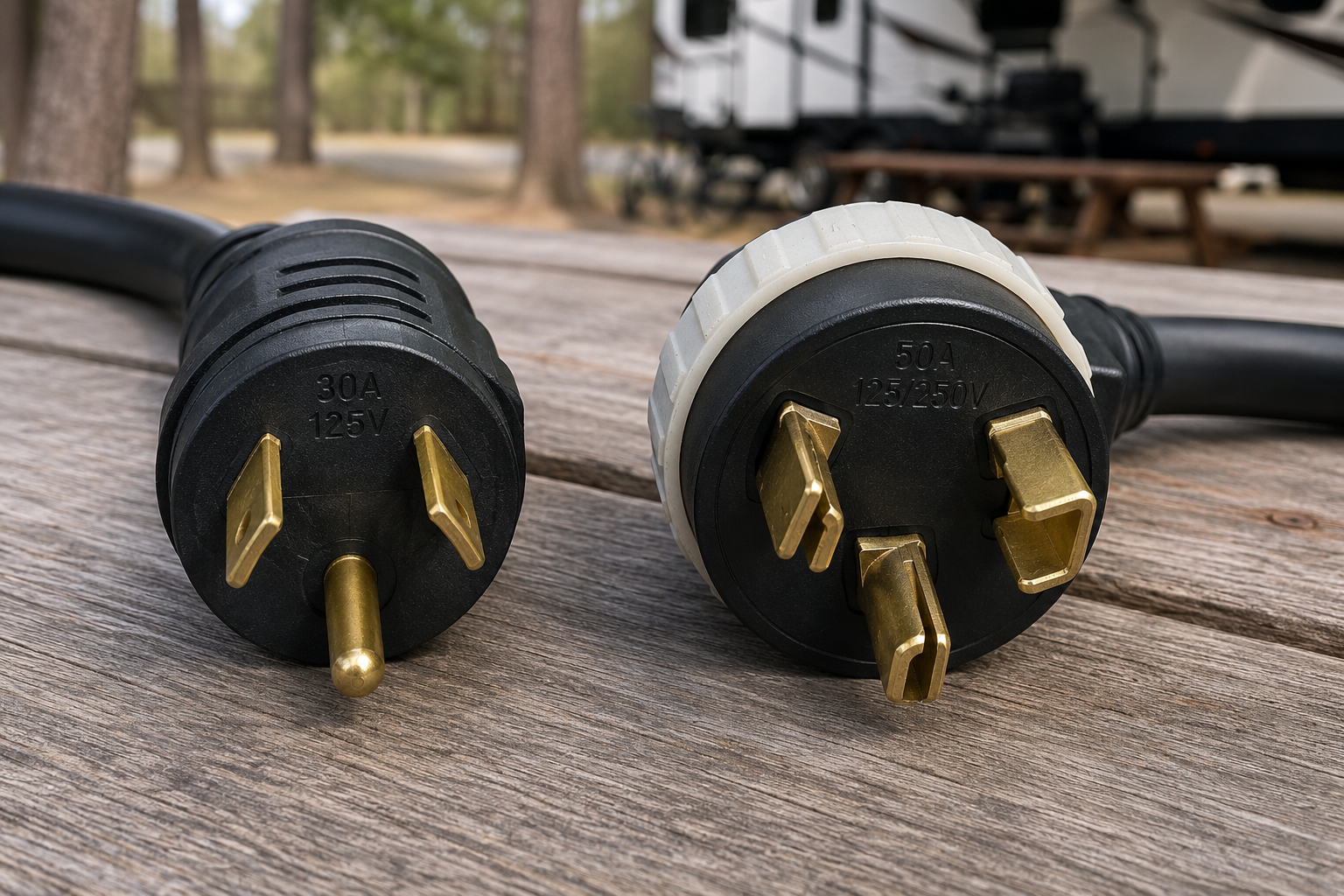
Why 30 Amp vs. 50 Amp Matters
When we had our Class C motorhome, it had 30-amp service. Our Class A has 50-amp service. Somewhere between those two RVs, I learned that 30-amp vs. 50-amp RV power means a lot more than having a different plug on the end of the shore power cord.
I learned part of that lesson the hard way on one of our early camping trips.
Apparently, a hair dryer can be quite a power hog. I plugged mine in while other things in the RV were already running and quickly tripped a breaker. Nothing was damaged. The breaker did exactly what it was supposed to do, but I certainly learned that you can’t just keep plugging things in and expect a 30-amp RV to happily provide more power.
For the record, we’ve moved up to a 50-amp motorhome, and I still leave the hair dryer at home.
Understanding 30-amp vs. 50-amp RV power doesn’t require an electrical engineering degree. You really just need to understand how much power is available and why that affects what you can use at the same time.
What Does 30 Amp vs. 50 Amp Actually Mean?
The simplest explanation is that amperage tells you how much electrical power your RV has available to use. A 30-amp RV connection provides about 3,600 watts of power. A 50-amp RV connection can provide up to about 12,000 watts. That difference surprised me. Fifty-amp service sounds like it should provide only a little more power than 30-amp service. In reality, an RV with 50-amp service has more than three times the available power.
Why such a big difference? A 30-amp RV connection uses one 120-volt line. A 50-amp RV connection uses two 120-volt lines, each capable of supplying up to 50 amps. You don’t need to understand the electrical theory behind that to use your RV. Just remember that 50-amp RV service provides considerably more available power than 30-amp service.
That extra power becomes important when you start turning things on.
What Can You Run on 30 Amp?
This was the part I needed someone to explain when we bought our first RV. Do I need to know how many amps the toaster uses? Should I add up the microwave, air conditioner, and coffee maker before turning something else on? Or do I just plug in the toaster and hope for the best?
Fortunately, you don’t need to walk around your RV with a calculator.
What you do need to recognize are the appliances that use a lot of electricity. A good clue is heat. Appliances that create heat often use quite a bit of power. Hair dryers, space heaters, toasters, coffee makers, and electric skillets are good examples. Your microwave and air conditioner can also place a significant demand on the electrical system.
That doesn’t mean you can’t use them in a 30-amp RV. We certainly used our microwave, coffee maker, and air conditioner in ours. It means you need to pay attention to how many high-power appliances you’re using at the same time. If the air conditioner is already working hard and you turn on another appliance that requires a lot of electricity, you may exceed the power available.
That’s when a breaker may trip.
A tripped breaker can be startling when you’re a new RV owner, but the breaker is protecting the electrical system. It shuts things down rather than allowing more electricity to flow through the circuit than it can safely handle. My hair dryer didn’t break our RV. I simply asked the electrical system for more power than it could provide at that moment.
Lesson learned.
Why 50 Amp Makes a Difference
Our Class A has two air conditioners, which is common on larger motorhomes. That alone makes 50 amp vs. 30 amp RV power much more important to us than it was with our Class C.
In South Texas, air conditioning isn’t exactly a luxury for much of the camping season. When both A/C units are needed to keep the motorhome comfortable, having 50-amp service gives us the electrical capacity the RV was designed to use. We also have more room to use everyday appliances without constantly thinking about what else is running. That doesn’t mean 50-amp gives you unlimited electricity. It simply gives a larger RV considerably more electrical capacity to work with.
Can a 50-Amp RV Use a 30-Amp Campsite?
Yes, a 50-amp RV can usually connect to a 30-amp campground pedestal with the proper adapter. We carry one for our Class A. But here’s the important part: An adapter changes the connection. It does not turn 30-amp service into 50-amp service. If our Class A is connected to a 30-amp pedestal, we’re still limited to the amount of power that 30-amp service can provide.
We’ve talked about using a 30-amp campsite during cooler weather when we might need only one air conditioner—or none at all with a little power management; that could work for us. During a South Texas summer when we want both air conditioners running? I’d rather have the 50-amp site. We’ll go deeper into whether you can plug a 30-amp RV into 50-amp service or a 50-amp RV into 30-amp service in another article. For now, remember that having the correct adapter doesn’t give your RV additional power.
Check the Amps Before You Reserve
Understanding 30-amp vs. 50-amp RV power also changed the way I make campground reservations. I once reserved a campsite at a Texas state park and didn’t pay enough attention to the electrical hookup. When I received the confirmation, I noticed our site had 30-amp service.
Oops.
I went back to change the reservation to a 50-amp site and discovered there weren’t any available. In fact, some older Texas state parks have more 30-amp sites than 50-amp sites. I canceled that reservation and booked another campground where 50-amp service was available.
Now I check before I book.
If the campground or reservation system doesn’t clearly tell me whether a campsite has 30-amp or 50-amp service, I call and ask. I’d much rather spend a few minutes verifying the electrical hookup at home than discover the problem after we’ve arrived.
If you’re still learning campground electrical hookups, What Is Shore Power? explains where your RV’s campground electricity comes from, while Shore Power vs. Generator explains the two common ways RVers supply power while camping.
30 Amp vs. 50 Amp Doesn’t Have to Be Complicated
The biggest thing to remember about 30 amp vs. 50 amp RV power is that you’re really talking about how much electricity your RV has available at one time. With 30-amp service, you’ll need to be a little more aware of high-power appliances and what you’re running together. With 50-amp service, you have considerably more capacity, which becomes especially important in larger RVs with multiple air conditioners.
You don’t need to memorize the electrical draw of every appliance in your RV. Learn which ones are your power hogs, pay attention to what you’re using at the same time, and let the circuit breakers do the safety job they were designed to do. And before you make that campground reservation, check the amperage.
That’s one lesson I’d rather learn from a confirmation email than from a hot motorhome in the middle of a Texas summer.
Author’s Note
When we started camping in our 30-amp Class C, I didn’t understand how much attention I needed to pay to what we were running at the same time. A tripped breaker—and one innocent-looking hair dryer—helped teach me pretty quickly. Our Class A has 50-amp service now, but I still check the electrical hookup before making a reservation. And yes, the hair dryer still stays home.